Tuesday, October 29, 2013

NSA Circus, Nobody Can Keep Their Story Straight

The story of NSA spying on Angela Merkel and other friendly heads of state is a prototypical one of Washington circus, which has prompted a new round of "Reviews" ordered by President Obama and Dianne Feinstein of the Senate Intelligence Committee.  According to the Guardian and CNN  there is a major fight brewing in the Administration over who is throwing whom under the bus.  He either knew and is denying it or he didn't know, which most people find not credible.  He either found about it last summer and ordered it stopped, or he let it go on.  Incredible stuff, but in my view we won't find out from any of the current circus performers, they all have no credibility.  I wouldn't trust anybody's word unless it came from Ron Wyden or Mark Udall, and so far they aren't saying.

First CNN.
It's plausible that Obama wouldn't know about specific surveillance targets, said CNN National Security Analyst Fran Townsend, a member of the CIA external advisory board.
She said overall intelligence collection priorities are well-known by the White House. "Specific targets, however, (like) Angela Merkel's cell phone, are not the sort of thing discussed with the President of the United States."
No one should expect the President to know everything the NSA is doing, said Julian Zelizer, a professor of history and public affairs at Princeton University.
"But when you're talking about the surveillance of world leaders, and an issue that's been controversial for a while now, you would expect that there's some knowledge either by the President or people surrounding him. ... I do think there's surprise that this was off the radar in the inner circles of the White House."
And from the Guardian,

Did President Obama know about US spying on its friends, apparently going back more than a decade in the case of Angela Merkel? The answer is either "Of course he did, idiot" or "It's plausible he didn't, actually" – depending on whom you ask.
The White House message is clear: the president was in the dark.
The Wall Street Journal quoted an anonymous administration official on Sunday saying that the president didn't find out until this summer about spying on allies and he immediately ordered it stopped. The Washington Post published a corroborating report Monday.
Obama himself told ABC News on Monday that the White House merely gives the intelligence community "policy direction":
I'm the final user of all the intelligence that they gather. But they're involved in a whole wide range of issues.
We give them policy direction. But what we've seen over the last several years is their capacities continue to develop and expand, and that's why I'm initiating now a review to make sure that what they're able to do doesn't necessarily mean what they should be doing.
To members of the intelligence community, the president distancing himself in this way from data collection that fed his daily briefings is a betrayal. The intelligence officials involved aren't taking it sitting down, either. "Current and former US intelligence officials" are talking to Ken Dilanian of the Los Angeles Times, among others. The White House "signed off on surveillance targeting phone conversations of friendly foreign leaders," he reports:
Obama may not have been specifically briefed on NSA operations targeting a foreign leader's cellphone or email communications, one of the officials said. 'But certainly the National Security Council and senior people across the intelligence community knew exactly what was going on, and to suggest otherwise is ridiculous.'

Monday, October 28, 2013

Oregon, Neurotic Extroverts in Short Supply

Oregon is officially a laid back agreeable creative openness State, according to an article published in a Time.com Science Page, which quotes a personality study of over a million people conducted by a multinational team of researchers led by psychologist and American expat Jason Rentfrow of the University of Cambridge in the U.K.  I took the snap personality test and they recommended I move to Oklahoma.  It might be interesting to take the test, then ask your closest companion to rate your personality and see how closely your answers are to your companions'. 

States were graded on 5 personality traits, and Oregon scored above the national average on Agreeableness and Openness, so maybe Portlandia isn't so far off the mark.  Sanity was not a factor although Neuroticism was, and we're ranked low on that one.  Take the test.

Sunday, October 27, 2013

Tea Party Club For Growth Wants Greg Walden Out

Oregons' only GOP Representative has been targeted by the Tea Party Club for Growth in the GOP primary according to Oregonlive.com, they potentially could be backing Klamath County Chairman Dennis Linthicum against Walden.
Walden, who was first elected in 1998, has been well-entrenched in his vast district and has had little serious competition since -- particularly in the Republican primary.  He is in the House leadership by virtue of his chairmanship of the National Republican Congressional Committee, which oversees the House GOP campaign effort.
But earlier this year, the Club for Growth -- a conservative group that often spends heavily in Republican races -- put Walden on its "Primary My Congressman" list of GOP members the group thinks should be ousted.
The immediate cause of the group's unhappiness was Walden's opposition to a proposal by President Barack Obama -- and supported by several Republican leaders -- to adopt smaller cost-of-living increases for Social Security recipients.  The group cited that, as well as several of his votes, as examples of a "long record of supporting increases in government spending and opposing fiscally conservative proposals."
Linthicum said he thinks he can win support from grassroots groups, particularly those involved in the Tea Party movement.  "I think the Tea Party individuals...are clearly in my camp," he said.
Linthicum recently took credit for Walden's vote against the budget deal that ended the shutdown, saying that he too would would have opposed the deal because it did not provide major spending reductions.
Walden has said he opposed the deal because it "kicks the can down the road" without providing a solution.  It marked one of the rare times that Walden had parted ways with House Speaker John Boehner on a major fiscal issue.

Saturday, October 26, 2013

Blame It All On Snowden?

President Obama and the NSA brass have exhibited a basic flaw that has been exposed throughout the Snowden revelations, they make bad (I mean really bad) decisions and don't own up to them.  The US Press is still giving cover with soothing editorials, in one particularly mild, and offensive, NY Times article, they find no fault or deficiency in the decisions made, and in fact imply the NSA is out of control, totally ignoring the excuses President Obama has made for their actions.  It's clear that these were decisions made by Presidents Bush and Obama, not some out of control bureaucracy.  The NY Times helpfully offers this advice.
A good way out of this mess would be for Washington to take up the proposal made Friday by Germany and France to negotiate a formal pact that would set mutually acceptable surveillance guidelines.
The US press ought to be calling for blood on the floor, all the brass at the NSA, Feinstein, Chambliss, and all the rest of the toadying hawks on the Intelligence Committees.  The president has an opportunity to be presidential, but he's behaving like a school child caught shoplifting a pack of gum.  As for the NSA brass, General Keith Alexander is mouthing off that it's the fault of the press.  Glenn Greenwald and the Guardian have the only coverage fit to print.
Speaking of an inability to maintain claims with a straight face, how are American and British officials, in light of their conduct in all of this, going to maintain the pretense that they are defenders of press freedoms and are in a position to lecture and condemn others for violations? In what might be the most explicit hostility to such freedoms yet – as well as the most unmistakable evidence of rampant panic – the NSA's director, General Keith Alexander, actually demanded Thursday that the reporting being done by newspapers around the world on this secret surveillance system be halted (Techdirt has the full video here):
The head of the embattled National Security Agency, Gen Keith Alexander, is accusing journalists of "selling" his agency's documents and is calling for an end to the steady stream of public disclosures of secrets snatched by former contractor Edward Snowden.
"I think it's wrong that that newspaper reporters have all these documents, the 50,000 – whatever they have and are selling them and giving them out as if these – you know it just doesn't make sense," Alexander said in an interview with the Defense Department's "Armed With Science" blog.
"We ought to come up with a way of stopping it. I don't know how to do that. That's more of the courts and the policy-makers but, from my perspective, it's wrong to allow this to go on," the NSA director declared. [My italics]
There are 25,000 employees of the NSA (and many tens of thousands more who work for private contracts assigned to the agency). Maybe one of them can tell The General about this thing called "the first amendment".

NSA, Your Tax Dollars At Work

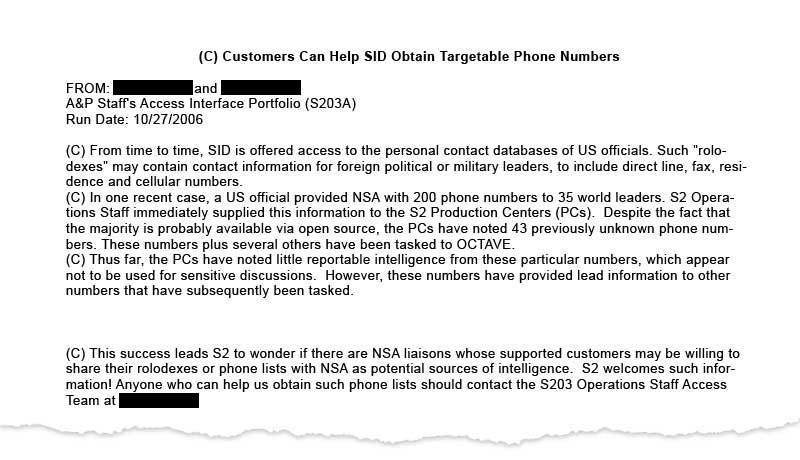
The Whistleblower Edward Snowden came across a Bush era NSA memo to its staff in 2006 that encouraged them to have their "Customers" (White House, State Dept, etc,) pass along any phone numbers of important people so the NSA could tap their phones, as reported in The Guardian.
In addition to snooping on world leaders, the NSA has intercepted phone calls around the world seemingly at random, collecting lots of juicy personal details, but doing nothing to stop terrorism.
But the memo acknowledges that eavesdropping on the numbers had produced "little reportable intelligence". In the wake of the Merkel row, the US is facing growing international criticism that any intelligence benefit from spying on friendly governments is far outweighed by the potential diplomatic damage.
The memo then asks analysts to think about any customers they currently serve who might similarly be happy to turn over details of their contacts.
"This success leads S2 [signals intelligence] to wonder if there are NSA liaisons whose supported customers may be willing to share their 'Rolodexes' or phone lists with NSA as potential sources of intelligence," it states. "S2 welcomes such information!"
They've managed to piss off everybody in Brazil, France and Germany, among others.  Putin isn't too thrilled either, but hey, he's Russian so I guess he doesn't count.

Friday, October 25, 2013

Money, Politics and Corruption

While our government was awash in corruption before Citizens United created a PAC frenzy, the Center for Public Integrity reports over the top numbers for lobbyists, and it's not even peak election season yet, this looks to be a record year for lobbyists throwing money at government.
But prompted in part by roiling debate over a national farm bill, the Grocery Manufacturers Association reported spending $7.47 million to influence the federal government — never before had it cracked the $2 million mark for a single quarter. A representative for the association could not be reached for comment.
Ahead of Obamacare implementation on Oct. 1, drug makers Amgen Inc. ($2.52 million) and GlaxoSmithKline ($1.27 million), increased their quarterly lobbying expenditures compared to the third quarter of 2012. So did other large lobbying forces with prominent health care interests, such as the American Chemistry Council ($4.75 million), American Medical Association ($4.27 million) and the Biotechnology Industry Organization ($2.02 million).
AT&T Inc., oil company Chevron Corp., Coca-Cola Co., defense contractor Raytheon Co., United Parcel Service, tech firm Hewlett-Packard and bank Wells Fargo also recorded spending increases compared to their performances during last year’s third quarter.
And prominent members of the gun lobby — both for and against firearm restrictions — also topped totals from 2012’s third quarter, although their spending levels were generally down from the previous quarter this year.

Saturday, October 19, 2013

Cover Oregon Still Not Functional

First target date of Oct 1 2013 was missed, then the second date Oct 15, 2013 flew by as well, and now they are hoping to be up by the end of October.  The vendor, Oracle Corp is struggling, and may get dinged financially for failing to get the program on track according to Rocky King, the director appointed by John Kitzhaber.
"The product has not been at a quality level that has not been satisfactory to me and they (Oracle) know that," King said, adding that the testing happened so late that the exchange was unaware of the extent of problems.
He says the state has not yet decided whether to withhold contractual payments to Oracle in light of the delays. "I have not been in the mode of pointing fingers, I have been in the mode of getting this up and running," he said.
Documents also show that officials were over-optimistic. According to an application for more grant money in March 2012, Oregon had earlier underestimated its needs.
I hope they do get on track soon or it will be judged a train wreck.  My sympathies to Rocky, he sounds like a good administrator working through a gnarly project.