Showing posts with label government spying. Show all posts
Showing posts with label government spying. Show all posts
Tuesday, August 26, 2014
Oregon Should Put Limits on Drones
I'll send an email to my Oregon State Representatives suggesting Oregon should follow up on California's initiative in limiting Drone use in Law Enforcement. I think it would "fly" here too. If only we could do the same with Automated License Plate Tracking.

Saturday, August 16, 2014
Ron Wyden Battles On For Civil Rights
I don;t think I can come up with any commentary other than to quote excerpts from Wyden's speech to the TechFestNW event in Portland on Friday, August 15, 2014. He is a wise thinker on government power to do good or evil in the digital age. Read the full speech.
For centuries, individual privacy was protected to a large extent by the limited resources of governments. It simply wasn’t possible for governments to secretly collect huge amounts of personal information about every single citizen without building massive networks of spies and informants. ...Our luck has run out. Here in the 21st century, this dynamic has already shifted in a profound and fundamental way. Advances in technology have made it possible for governments around the world to vacuum up and rifle through the personal information of huge numbers of law-abiding citizens. If you would defend a society built on the principle of individual liberty you need to recognize that you can no longer rely on the fact that mass surveillance is hard – in the 21st century, it’s easy. The only protections that we can count on now are those that are written into law, upheld by a responsible judiciary, and enforced by a public willing to stand up for their own freedoms. Fortunately, our Founding Fathers left us with some pretty darn good legal principles that can guide us when it comes to privacy. The Fourth Amendment guarantees the fundamental right of the people to be secure from unreasonable searches and seizures. Justice Louis Brandeis called this the right to be left alone.
Tuesday, April 1, 2014
NSA - Ain't Nobody Safe
The NSA has confirmed in an article from The Guardian that a loophole in the restrictions against domestic spying was employed to search US citizens communications without any warrant. This should probably come as no surprise given that NSA will use any opening to do whatever they like to anybody. Senator Ron Wyden initiated the question, finally responded to by James Clapper in typical elaborate double-talk.
Ron Wyden and Mark Udall responded.“There have been queries, using US person identifiers, of communications lawfully acquired to obtain foreign intelligence targeting non-US persons reasonably believed to be located outside the United States,” Clapper wrote in the letter, which has been obtained by the Guardian.
“These queries were performed pursuant to minimization procedures approved by the Fisa court and consistent with the statute and the fourth amendment.”
On Tuesday, Wyden and Udall said the NSA’s warrantless searches of Americans’ emails and phone calls “should be concerning to all.”
“This is unacceptable. It raises serious constitutional questions, and poses a real threat to the privacy rights of law-abiding Americans. If a government agency thinks that a particular American is engaged in terrorism or espionage, the fourth amendment requires that the government secure a warrant or emergency authorisation before monitoring his or her communications. This fact should be beyond dispute,” the two senators said in a joint statement.
They continued: “Today’s admission by the Director of National Intelligence is further proof that meaningful surveillance reform must include closing the back-door searches loophole and requiring the intelligence community to show probable cause before deliberately searching through data collected under section 702 to find the communications of individual Americans."
Sunday, January 26, 2014
Republicans take on NSA
I never thought I would agree to anything the Republican party did, but they finally came up with a position I agree with as reported in The Guardian. The Republican National Committee adopted a resolution denouncing the NSA bulk collection of phone data in the US, which they learned about thanks to Edward Snowden. Now if they were kind enough to thank him and accord him whistleblower status, I might have to think more kindly of them, at least for a few minutes.
In its resolution, the RNC also called for a special committee to “investigate, report, and reveal to the public the extent of this domestic spying” and “hold accountable those public officials who are found to be responsible for this unconstitutional surveillance”. The resolution goes on to say that “the mass collection and retention of personal data is in itself contrary to the right of privacy protected by the fourth amendment of the United States constitution". “I think that the committee's resolution this morning was about reflecting where it thinks sentiment lies,” the RNC deputy press secretary, Raffi Williams, told the Guardian.
“The Republican National Committee encourages Republican lawmakers to enact legislation to amend Section 215 of the USA Patriot Act, the state secrets privilege, and the Fisa Amendments Act to make it clear that blanket surveillance of the internet activity, phone records and correspondence – electronic, physical, and otherwise – of any person residing in the US is prohibited by law and that violations can be reviewed in adversarial proceedings before a public court,” the resolution says.No word if George W Bush and Dick Cheney will be hauled before a congressional committee.
It also “encourages Republican lawmakers to immediately take action to halt current unconstitutional surveillance programs and provide a full public accounting of the NSA’s data collection programs”.
Saturday, January 18, 2014
NSA Reform Misdirection
President Obama gave the big NSA reform pitch, but it didn't make many people happy, for a lot of different reasons. My own reaction is pretty unhappy, he danced around big issues while trying to dress the NSA in pretty clothes. Some of the issues I have involve the government arbitrarily and secretly assuming the right to spy on innocent citizens, and to punish anyone who reveals it as a traitor, their persecution of Edward Snowden is classical police state stuff. Over at The Guardian Glenn Greenwald has branded it mostly PR fluff. The ACLU says:
“The president’s speech outlined several developments which we welcome. However, the president’s decision not to end bulk collection and retention of all Americans’ data remains highly troubling. The president outlined a process to study the issue further and appears open to alternatives. But the president should end – not mend – the government’s collection and retention of all law-abiding Americans’ data. When the government collects and stores every American’s phone call data, it is engaging in a textbook example of an ‘unreasonable search’ that violates the Constitution. The president’s own review panel recommended that bulk data collection be ended, and the president should accept that recommendation in its entirety.” See this link for an analysis of what got fixed and what didn't.I completely agree with the ACLU when they say the government "is engaging in a textbook example of an ‘unreasonable search’ that violates the Constitution.", but the defenders of the status quo ignore that fact. Ron Wyden had this to say about it.
“After the long push to rein in overbroad surveillance powers, we are very pleased that the President announced his intent to end the bulk collection of Americans’ phone records. Ending this dragnet collection will go a long way toward restoring Americans’ constitutional rights and rebuilding the public’s trust. Make no mistake, this is a major milestone in our longstanding efforts to reform the National Security Agency’s bulk collection program.
We also believe that additional surveillance reforms are necessary, and we will continue to push for these reforms in the coming weeks and months. In particular, we will work to close the “back-door searches” loophole and ensure that the government does not read Americans’ emails or other communications without a warrant. We will work to ensure that intelligence activities do not recklessly undermine confidence in American IT products and American IT employers. We will also continue to press for meaningful reforms of the outdated Foreign Intelligence Surveillance court process. This should include the establishment of a strong, independent advocate to ensure that the Court hears both sides of the argument.
Friday, December 27, 2013
NSA Phone Metadata Dragnet Ruled "Legal and Necessary"
A federal court judge ruled that the NSA was perfectly within its rights to collect the phone records of every US citizen in an absurd ruling against the ACLU. The ACLU will appeal the dismissal of their lawsuit. As MSNBC reports,
When Judge William H. Pauley ruled that the National Security Agency’s metadata program was lawful on Friday, he argued that there was no significant dispute about “the effectiveness of bulk telephony metadata collection.”
Pauley–who issued his ruling from a courthouse less than two miles from where the twin towers once stood–then offered a series of examples cited by the NSA to bolster their claims that the program is effective, all of which have been “seriously disputed.”
Only four plots among the fifty-four the NSA claims to have helped foil have been made public. Pauley cited three of those four plots in arguing that the metadata program was effective, but journalists and legislators have picked already picked those examples apart. ProPublica published a piece in October by Justin Elliott and Theodoric Meyer noting that in each of the three cases Pauley mentions, there were serious doubts as to whether or not the NSA was exaggerating either the plot itself or the impact of the program.
Two Democratic members of the Senate intelligence committee, Ron Wyden of Oregon and Mark Udall of Colorado, said in July that the NSA has “significantly exaggerated this program’s effectiveness,” and warned that “assertions from intelligence agencies about the value and effectiveness of particular programs should not simply be accepted at face value.”
Aside from Leon and federal legislators, there’s one more entity that has disputed the usefulness of the NSA metadata program: The review board appointed by the White House itself. In their report, the board concluded that bulk collection of metadata “was not essential to preventing attacks.” After the report was released, one of the review board members, Geoffrey Stone, a University of Chicago law professor, told NBC News there was no evidence the program had thwarted any attacks.
Monday, December 16, 2013
Orwellian NSA Spying Ruled Unconstitutional
A Federal Court judge in Washington DC has ruled the NSA bulk phone metadata collection is unconstitutional under the Fourth Amendment protection against unreasonable searches without due process, and he called the program "Orwellian". Thanks to Edward Snowden the cracks in the NSA armor are about to break. The Guardian reports:
Judge Richard Leon declared that the mass collection of metadata probably violates the fourth amendment, which prohibits unreasonable searches and seizures, and was "almost Orwellian" in its scope. In a judgment replete with literary swipes against the NSA, he said James Madison, the architect of the US constitution, would be "aghast" at the scope of the agency’s collection of Americans' communications data. Leon’s opinion contained stern and repeated warnings that he was inclined to rule that the metadata collection performed by the NSA – and defended vigorously by the NSA director Keith Alexander on CBS on Sunday night – was unconstitutional. Jameel Jaffer, the deputy legal director of the ACLU, praised what he called Leon's "thoughtful" ruling: “This is a strongly worded and carefully reasoned decision that ultimately concludes, absolutely correctly, that the NSA’s call-tracking program can’t be squared with the constitution." In his ruling, Judge Leon expressly rejected the government’s claim that the 1979 supreme court case, Smith v Maryland, which the NSA and the Obama administration often cite to argue that there is no reasonable expectation of privacy over metadata, applies in the NSA’s bulk-metadata collection. The mass surveillance program differs so much from the one-time request dealt with by the 1979 case that it was of “little value” in assessing whether the metadata dragnet constitutes a fourth amendment search.
Thursday, December 12, 2013
NSA Uses Google Cookies to Target Suspects
The new revelation reported in the Washington Post is not that earth shaking in itself, but it points out how the NSA builds big haystacks of data, making it harder to find a needle. The experienced terrorist is probably not using Google to roam the internet, so a lot of effort by the NSA probably only tracks the average person, whether they are in the US, Brazil or Germany. It is intrusive surveillance of people not suspected of doing anything bad.
Separately, the NSA is also using commercially gathered information to help it locate mobile devices around the world, the documents show. Many smartphone apps running on iPhones and Android devices, and the Apple and Google operating systems themselves, track the location of each device, often without a clear warning to the phone's owner. This information is more specific than the broader location data the government is collecting from cellular phone networks, as reported by the Post last week.
"On a macro level, 'we need to track everyone everywhere for advertising' translates into 'the government being able to track everyone everywhere,'" says Chris Hoofnagle, a lecturer in residence at UC Berkeley Law. "It's hard to avoid."
Monday, December 9, 2013
NSA Targets Elves and Orcs
This has to be the most bizarre news story of the day. The Guardian is reporting that the NSA somehow believed terrorists might be lurking in the hordes of innocent gamers, so naturally they had to do something, not being content with capturing most of the internet traffic already, they had to become Elves and Pixies to root out the terrorists! One unnamed analyst was given the task of writing up the justification, with comical rationale.
A 2007 invitation to a secret internal briefing noted "terrorists use online games – but perhaps not for their amusement. They are suspected of using them to communicate secretly and to transfer funds." But the agencies had no evidence to support their suspicions.This sounded like such fun that the UK's GCHQ, the FBI, CIA, and the Defense Humint Service had to develop their own programs to stem this deadly menace. Now we know what those folks are doing at work.
In fact, so crowded were the virtual worlds with staff from the different agencies, that there was a need to try to "deconflict" their efforts – or, in other words, to make sure each agency wasn't just duplicating what the others were doing.
By the end of 2008, such efforts had produced at least one usable piece of intelligence, according to the documents: following the successful takedown of a website used to trade stolen credit card details, the fraudsters moved to Second Life – and GCHQ followed, having gained their first "operational deployment" into the virtual world. This, they noted, put them in touch with an "avatar [game character] who helpfully volunteered information on the target group's latest activities".
The agencies had other concerns about games, beyond their potential use by terrorists to communicate. Much like the pressure groups that worry about the effect of computer games on the minds of children, the NSA expressed concerns that games could be used to "reinforce prejudices and cultural stereotypes", noting that Hezbollah had produced a game called Special Forces 2.Well if we needed some comic relief in the never ending trove of Edward Snowden and the masters of spycraft, this will do for today.
Wednesday, December 4, 2013
If You Have a Cell Phone, The NSA Knows Where You Are
The Washington Post has broken a new story based on internal NSA documents courtesy of Edward Snowden, it turns out the NSA is intercepting data worldwide from major cell telecoms and storing billions of records daily of cell phones proximity to cell towers. This gives them a global surveillance capability, able to track anybody with a cell phone down to a city block location. They have software filtering the mass ocean of data looking for interesting people and who they might pass by. You can only hope you're not one of them.
(Reuters) - The National Security Agency gathers nearly 5 billion records a day on the location of mobile telephones worldwide, including those of some Americans, the Washington Post reported on Wednesday, citing sources including documents obtained by former NSA contractor Edward Snowden.
The records feed a database that stores information about the locations of "at least hundreds of millions of devices," the newspaper said, according to the top-secret documents and interviews with intelligence officials.
The report said the NSA does not target Americans' location data intentionally, but acquires a substantial amount of information on the whereabouts of domestic cellular telephones "incidentally."
One manager told the newspaper the NSA obtained "vast volumes" of location data by tapping into the cables that connect mobile networks globally and that serve U.S. cellphones as well as foreign ones.
Previously, in late September, Senator Ron Wyden asked NSA director Gen. Keith Alexander during a Senate hearing if the agency had ever made plans to collect Americans’ cell site location data. But, Alexander, after Wyden repeated his question, said the Foreign Intelligence Surveillance Court needed notice if the NSA wanted to collect cell site location records. He then said he did not want to put anything out that would be classified.
Tuesday, November 26, 2013
UN to Declare Human Right to Privacy
A non-binding UN resolution that declares a "human right to privacy" as a basic right is being drafted and will come up for a vote soon. The US and UK are opposing the language, as it would put them in violation, but given that the US has tortured, kidnapped and killed civilians with drones, this is just another mosquito bite for the government. It will however keep the topic in the public eye, although The Guardian appears to be the only media paying any attention to the story, I didn't see any other stories in the US press. We can thank Edward Snowden for the world becoming aware of the US / UK excessive usurping of basic human rights.
The United Nations moved a step closer to calling for an end to excessive surveillance on Tuesday in a resolution that reaffirms the “human right to privacy” and calls for the UN’s human rights commissioner to conduct an inquiry into the impact of mass digital snooping.
A UN committee that deals with human rights issues adopted the German- and Brazilian-drafted resolution that has become an increasingly sensitive issue among UN members.
The resolution, titled “The right to privacy in the digital age”, does not name specific countries but states the UN is: “Deeply concerned at the negative impact that surveillance and/or interception of communications … may have on the exercise and enjoyment of human rights.”
The resolution says “unlawful or arbitrary” surveillance may “contradict the tenets of a democratic society”. It says states “must ensure full compliance with their obligations under international human rights law”.
The 193-member general assembly is expected to vote on the non-binding resolution next month.
The resolution was co-sponsored by Brazil and Germany after leaked documents from former National Security Agency consultant Edward Snowden revealed that the agency had spied on their political leaders.
Saturday, November 9, 2013
Ron Wyden, "The Culture of Misinformation"
Ron Wyden comments on the bill passed by the US Senate Intelligence Committee over his objections in an interview with The Oregonian yesterday.
Wyden also commented to The Guardian recently.
After a dozen years on the Senate Intelligence Committee, Ron Wyden doesn't get surprised easily. But Gen. Keith Alexander, director of the National Security Agency, recently managed it, by assuring the committee that the NSA planned to put bulk data it had collected on American citizens into a secure lockbox.
Repeatedly, the Oregon senator recalls, Alexander had told the committee the NSA didn't hold data on American citizens. "Now," says Wyden, "he said he's going to put into a lockbox the data that he's said he doesn't have."
"The culture of misinformation," he says, "has caused a lot of people to say, they're telling us stuff that just isn't true." Even the supersecret Foreign Intelligence Surveillance Act court, Wyden points out, has ruled that NSA has sometimes exceeded its legal and constitutional authority.
Wyden is introducing his own bill, very different from the committee's, that would prevent bulk data collection on American citizens, create an independent counsel to respond to NSA surveillance requests to the FISA court and eliminate "backdoor" breaking into social media systems. Sen. Patrick Leahy, D-Vt., chairman of the Senate Judiciary Committee, has introduced similar legislation, and last week Leahy and Wyden formed an alliance, becoming co-sponsors of each others' bills.
Wyden also commented to The Guardian recently.
Ron Wyden said the bill maintains "business as usual" and "remains far from anything that could be considered meaningful reform".
Spies Breach "Fundamental Rights" in EU
The Guardian is reporting on continued outrage in Europe over the spying by the NSA and France, Germany, the Netherlands and Sweden. An analysis presented to a hearing in the EU parliament in Brussels argues that EU law prohibits the actions of the spy agencies.
Sergio Carrera, a Spanish jurist, and Francesco Ragazzi, a professor of international relations at Leiden University in the Netherlands, who co-wrote the paper, made the appeal for European action at a hearing in the EU parliament in Brussels on Thursday.
They said the US National Security Agency (NSA), the UK's GCHQ and equivalent bodies in France, Germany, the Netherlands and Sweden had breached basic articles of the EU treaty, such as article 4.3 on "sincere co-operation", as well as privacy clauses in the EU charter of fundamental values and in the European charter of fundamental rights.
"It's no longer credible to say the EU has no legal competence and should do nothing on this. Sorry, we don't think this is acceptable," Carrera said.
"We are witnessing a systematic breach of people's fundamental rights," he added.
Ragazzi said: "The bigger the crisis, the more the system of checks and balances should be reinforced. This is what distinguishes democracies from police states."
The idea that espionage is a national prerogative has been widely used to deflect EU queries into the scandal.
They said the EU parliament should threaten to block an EU-US free trade agreement unless the NSA and GCHQ disclose the full nature of their surveillance programmes.
They said MEPs should push EU countries to draft a "professional code for the transnational management of data".
They also called for new EU laws to stop internet companies giving information to intelligence services, to protect whistleblowers such as the NSA leaker Edward Snowden, and to form a permanent oversight body on intelligence matters.
Sunday, November 3, 2013
Edward Snowden Picks Up Support in Germany
The Guardian is reporting on an article in the German weekly Der Spiegel that many highly placed Germans are calling for recognition of Edward Snowden as a whistleblower instead of a criminal, and some are advocating he be offered asylum in Germany, not that it would likely be adopted by Angela Merkel. Snowdens' temporary 1 year asylum runs out next June.
Heiner Geissler, the former general secretary of Angela Merkel's Christian Democrats, says in the appeal: "Snowden has done the western world a great service. It is now up to us to help him." The writer and public intellectual Hans Magnus Enzensberger argues in his contribution that "the American dream is turning into a nightmare" and suggests that Norway would be best placed to offer Snowden refuge, given its track record of offering political asylum to Leon Trotsky in 1935. He bemoans the fact that in Britain, "which has become a US colony", Snowden is regarded as a traitor.
The weekly news magazine also publishes a "manifesto for truth", written by Snowden, in which the former NSA employee warns of the danger of spy agencies setting the political agenda.
"At the beginning, some of the governments who were exposed by the revelations of mass surveillance initiated an unprecedented smear campaign. They intimidated journalists and criminalised the publication of the truth
"Today we know that this was a mistake, and that such behaviour is not in the public interest. The debate they tried to stop is now taking place all over the world", Snowden writes in the short comment piece sent to Der Spiegel via an encrypted channel.
As calls for drastic measures in response to the NSA revelations are increasing in Germany, Angela Merkel seems to be avoiding direct confrontation with Washington. Several politicians from the chancellor's party have expressed their eagerness to meet Snowden in Russia while simultaneously seeming to rule out the possibility of inviting the whistleblower to Germany. "There is no reason to make a call on a Snowden stay in Germany at this stage," Michael Grosse-Brömer told Rhein-Neckar-Zeitung.
Saturday, November 2, 2013
Ron Wyden and the NSA Steamroller
“We’re just going to keep fighting this battle.
It’s going to be a long one.”
Ron Wyden has his hands full in trying to rein in the NSA steamroller, which has powerful allies in Congress, such as Dianne Feinstein, Chair of the Senate Intelligence Committee, and Saxby Chambliss a Georgia Republican on the same committee. Wyden has labeled their ilk the "Business as Usual Brigade", and true to form they steamrolled a NSA "reform" bill that just continues business as usual with a few weak tweaks to existing practice.
Ron Wyden has his hands full in trying to rein in the NSA steamroller, which has powerful allies in Congress, such as Dianne Feinstein, Chair of the Senate Intelligence Committee, and Saxby Chambliss a Georgia Republican on the same committee. Wyden has labeled their ilk the "Business as Usual Brigade", and true to form they steamrolled a NSA "reform" bill that just continues business as usual with a few weak tweaks to existing practice.
The bill is a direct challenge to one introduced Tuesday by senator Patrick Leahy that would end domestic phone-records collection. It was also opposed by leading intelligence committee member Mark Udall, who said it did not go far enough.
"The NSA's invasive surveillance of Americans' private information does not respect our constitutional values and needs fundamental reform, not incidental changes. Unfortunately, the bill passed by the Senate intelligence committee does not go far enough to address the NSA's overreaching domestic surveillance programs," Udall said.
Another Democratic member of the committee, Ron Wyden, said the bill maintains "business as usual" and "remains far from anything that could be considered meaningful reform".
Wyden suggested that recent concern about NSA spying on foreign leaders had distracted from the real focus on mass domestic surveillance in the US. “The statements that American intelligence officials have made this week about collecting on the intentions of foreign leadership, that’s consistent with the understanding I’ve had for years, as a member of the intelligence committee,” he said.
“That has implications for foreign policy. My top priority is ending the mass surveillance, digital surveillance, on millions and millions of law-abiding Americans.”
Feinstein unexpectedly announced on Monday that she was “totally opposed” to the foreign leader spying of the sort the NSA conducts of German chancellor Angela Merkel. Feinstein has been a staunch supporter of the NSA’s bulk collection of Americans’ phone records.
“Americans are making it clear, that they never – repeat never – agreed to give up their constitutional liberties for the appearance of security,” Wyden said. “We’re just going to keep fighting this battle. It’s going to be a long one.”
Tuesday, October 29, 2013
NSA Circus Returns to Congress
Clapper and Alexander on the NSA road comedy tour went to hearings before the House intelligence committee, and did their usual act. Why do those people still have jobs?
- Should the power of the NSA be limited more? No. We prevented 54 plots, don't ask me how.
- Did Obama order surveillance of Angela Merkel? Maybe, I don't know. Somebody did.
Dancing around the central question of how much Obama knew about NSA spying on foreign leaders, Clapper testified that the intelligence agencies “do only what the policymakers, writ large, have actually asked us to do.” But he added that the “level of detail” about how those requirements are implemented rarely rises to the attention of presidents.Clapper and Alexander with their arrogant attitudes act as if the fix is in and nothing will change. Considering they still have jobs in government, maybe they're right, nothing has changed so far.
NSA Circus, Nobody Can Keep Their Story Straight
The story of NSA spying on Angela Merkel and other friendly heads of state is a prototypical one of Washington circus, which has prompted a new round of "Reviews" ordered by President Obama and Dianne Feinstein of the Senate Intelligence Committee. According to the Guardian and CNN there is a major fight brewing in the Administration over who is throwing whom under the bus. He either knew and is denying it or he didn't know, which most people find not credible. He either found about it last summer and ordered it stopped, or he let it go on. Incredible stuff, but in my view we won't find out from any of the current circus performers, they all have no credibility. I wouldn't trust anybody's word unless it came from Ron Wyden or Mark Udall, and so far they aren't saying.
First CNN.
First CNN.
And from the Guardian,It's plausible that Obama wouldn't know about specific surveillance targets, said CNN National Security Analyst Fran Townsend, a member of the CIA external advisory board.She said overall intelligence collection priorities are well-known by the White House. "Specific targets, however, (like) Angela Merkel's cell phone, are not the sort of thing discussed with the President of the United States."No one should expect the President to know everything the NSA is doing, said Julian Zelizer, a professor of history and public affairs at Princeton University."But when you're talking about the surveillance of world leaders, and an issue that's been controversial for a while now, you would expect that there's some knowledge either by the President or people surrounding him. ... I do think there's surprise that this was off the radar in the inner circles of the White House."
Did President Obama know about US spying on its friends, apparently going back more than a decade in the case of Angela Merkel? The answer is either "Of course he did, idiot" or "It's plausible he didn't, actually" – depending on whom you ask.
The White House message is clear: the president was in the dark.
The Wall Street Journal quoted an anonymous administration official on Sunday saying that the president didn't find out until this summer about spying on allies and he immediately ordered it stopped. The Washington Post published a corroborating report Monday.
Obama himself told ABC News on Monday that the White House merely gives the intelligence community "policy direction":
I'm the final user of all the intelligence that they gather. But they're involved in a whole wide range of issues.To members of the intelligence community, the president distancing himself in this way from data collection that fed his daily briefings is a betrayal. The intelligence officials involved aren't taking it sitting down, either. "Current and former US intelligence officials" are talking to Ken Dilanian of the Los Angeles Times, among others. The White House "signed off on surveillance targeting phone conversations of friendly foreign leaders," he reports:
We give them policy direction. But what we've seen over the last several years is their capacities continue to develop and expand, and that's why I'm initiating now a review to make sure that what they're able to do doesn't necessarily mean what they should be doing.
Obama may not have been specifically briefed on NSA operations targeting a foreign leader's cellphone or email communications, one of the officials said. 'But certainly the National Security Council and senior people across the intelligence community knew exactly what was going on, and to suggest otherwise is ridiculous.'
Saturday, October 26, 2013
Blame It All On Snowden?
President Obama and the NSA brass have exhibited a basic flaw that has been exposed throughout the Snowden revelations, they make bad (I mean really bad) decisions and don't own up to them. The US Press is still giving cover with soothing editorials, in one particularly mild, and offensive, NY Times article, they find no fault or deficiency in the decisions made, and in fact imply the NSA is out of control, totally ignoring the excuses President Obama has made for their actions. It's clear that these were decisions made by Presidents Bush and Obama, not some out of control bureaucracy. The NY Times helpfully offers this advice.
A good way out of this mess would be for Washington to take up the proposal made Friday by Germany and France to negotiate a formal pact that would set mutually acceptable surveillance guidelines.The US press ought to be calling for blood on the floor, all the brass at the NSA, Feinstein, Chambliss, and all the rest of the toadying hawks on the Intelligence Committees. The president has an opportunity to be presidential, but he's behaving like a school child caught shoplifting a pack of gum. As for the NSA brass, General Keith Alexander is mouthing off that it's the fault of the press. Glenn Greenwald and the Guardian have the only coverage fit to print.
Speaking of an inability to maintain claims with a straight face, how are American and British officials, in light of their conduct in all of this, going to maintain the pretense that they are defenders of press freedoms and are in a position to lecture and condemn others for violations? In what might be the most explicit hostility to such freedoms yet – as well as the most unmistakable evidence of rampant panic – the NSA's director, General Keith Alexander, actually demanded Thursday that the reporting being done by newspapers around the world on this secret surveillance system be halted (Techdirt has the full video here):
The head of the embattled National Security Agency, Gen Keith Alexander, is accusing journalists of "selling" his agency's documents and is calling for an end to the steady stream of public disclosures of secrets snatched by former contractor Edward Snowden.There are 25,000 employees of the NSA (and many tens of thousands more who work for private contracts assigned to the agency). Maybe one of them can tell The General about this thing called "the first amendment".
"I think it's wrong that that newspaper reporters have all these documents, the 50,000 – whatever they have and are selling them and giving them out as if these – you know it just doesn't make sense," Alexander said in an interview with the Defense Department's "Armed With Science" blog.
"We ought to come up with a way of stopping it. I don't know how to do that. That's more of the courts and the policy-makers but, from my perspective, it's wrong to allow this to go on," the NSA director declared. [My italics]
NSA, Your Tax Dollars At Work
The Whistleblower Edward Snowden came across a Bush era NSA memo to its staff in 2006 that encouraged them to have their "Customers" (White House, State Dept, etc,) pass along any phone numbers of important people so the NSA could tap their phones, as reported in The Guardian.
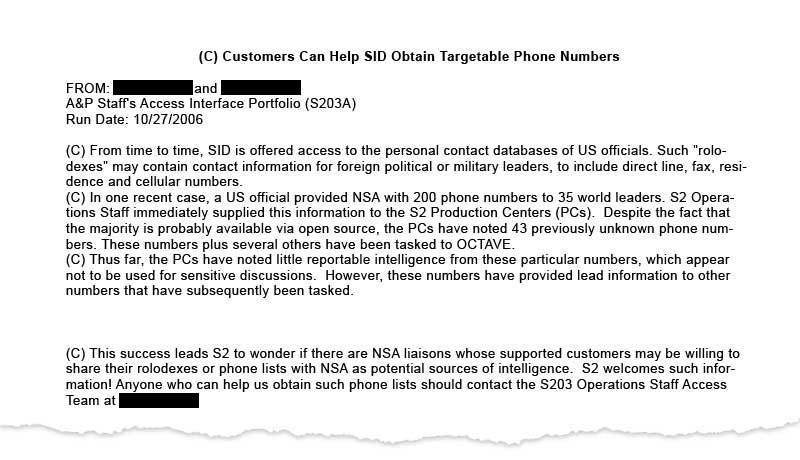 In addition to snooping on world leaders, the NSA has intercepted phone calls around the world seemingly at random, collecting lots of juicy personal details, but doing nothing to stop terrorism.
They've managed to piss off everybody in Brazil, France and Germany, among others. Putin isn't too thrilled either, but hey, he's Russian so I guess he doesn't count.But the memo acknowledges that eavesdropping on the numbers had produced "little reportable intelligence". In the wake of the Merkel row, the US is facing growing international criticism that any intelligence benefit from spying on friendly governments is far outweighed by the potential diplomatic damage.The memo then asks analysts to think about any customers they currently serve who might similarly be happy to turn over details of their contacts.
"This success leads S2 [signals intelligence] to wonder if there are NSA liaisons whose supported customers may be willing to share their 'Rolodexes' or phone lists with NSA as potential sources of intelligence," it states. "S2 welcomes such information!"
Saturday, October 12, 2013
Wyden, NSA, and the Business-as-Usual Brigade
If the government budget crisis ever ends, Senator Ron Wyden, Senator Patrick Leahy and Representative Jim Sensenbrenner all have a common goal, end the NSA bulk phone collection. Wyden says,
Sensenbrenner has also introduced legislation.
They will “try mightily to fog up the surveillance debate and convince Congress and the public that the real problem here is not overly intrusive, constitutionally flawed domestic surveillance, but sensationalistic media reporting”, Wyden said. “Their endgame is ensuring that any surveillance reforms are only skin deep.”
"Privacy protections that don’t actually protect privacy are not worth the paper they're printed on,” he said. “And just because intelligence officials say that a particular program helps catch terrorists doesn’t make it true.”
He was also sceptical about the Obama administration’s professed commitment to greater transparency. “When it comes to greater transparency and openness, the executive branch has shown little interest in lasting reforms that would actually make the intelligence community more open and transparent, and executive branch officials will probably resist any attempts to mandate greater transparency,” he said.
Wyden was scathing about the government’s “trust us” argument on surveillance, which he said was undermined by the NSA’s own track record. “The rules have been broken, and the rules have been broken a lot,” he said.
Sensenbrenner has also introduced legislation.
Sensenbrenner has called his bill the Uniting and Strengthening America by Fulfilling Rights and Ending Eavesdropping, Dragnet-Collection, and Online Monitoring Act – or USA Freedom Act, and a draft seen by the Guardian has four broad aims.
It seeks to limit the collection of phone records to known terrorist suspects; to end "secret laws" by making courts disclose surveillance policies; to create a special court advocate to represent privacy interests; and to allow companies to disclose how many requests for users' information they receive from the USA. The bill also tightens up language governing overseas surveillance to remove a loophole which it has been abused to target internet and email activities of Americans.
Subscribe to:
Posts (Atom)