Showing posts with label Edward Snowden. Show all posts

Monday, August 18, 2014

Obama War on Freedom of the Press

The NY Times reporter James Risen may be in jail weeks from now for refusing to reveal his sources in a case first involving George W Bush and then aggressively pursued by President Obama and Eric Holder. There is a petition in support of Risen, I invite all to sign it.  In an article in The Guardian, Rises says about Obama "He’s the greatest enemy to press freedom in a generation.”.  Those are pretty strong words, but a report by the Committee to Protect Journalists tells the tale, with nearly every journalist interviewed calling this administration the most hostile to the press in history.
Six government employees, plus two contractors including Edward Snowden, have been subjects of felony criminal prosecutions since 2009 under the 1917 Espionage Act, accused of leaking classified information to the press—compared with a total of three such prosecutions in all previous U.S. administrations.  
 “This is the most closed, control freak administration I’ve ever covered,” said David E. Sanger, veteran chief Washington correspondent of The New York Times.  
New York Times public editor Margaret Sullivan wrote earlier this year, “it’s turning out to be the administration of unprecedented secrecy and unprecedented attacks on a free press.”  
“President Obama had said that default should be  disclosure,” Times reporter Shane told me. “The culture they’ve created is not one that favors disclosure.”  The administration’s war on leaks and other efforts to control information are the most aggressive I’ve seen since the Nixon administration, when I was one of the editors involved in The Washington Post’s investigation of Watergate. The 30 experienced Washington journalists at a variety of news organizations whom I interviewed for this report could not remember any precedent.

Friday, May 30, 2014

Congress Trashes the Constitution, Blames Snowden

The NSA and Corporate Media are waging a bizarre sideshow over whether Edward Snowden tried to raise his concerns inside the NSA about their disregard of Constitutional protections of US citizens.  Wait a minute, these folks are arguing that he should have raised his voice privately to the folks running the unconstitutional operation?  You gotta be kidding, he'd have been squashed and locked up in some hole in a distant country and he knew it.  Even Ron Wyden didn't reveal it to the public because it would have been the end of his career.  The Intelligence game is rigged against whistleblowers and everybody knows it.

The current sideshow from Dianne Feinstein alleges essentially that Snowden didn't try to single handedly stop the criminal actions of Congress, the President and the NSA.  As The Guardian reported, first everybody claimed there were No emails on the subject, then claimed they found one email.  You can bet your ass there's lots more they're hiding, but even if there's only one the fact remains that whistleblowers were on a suicide journey if they told their bosses that they were criminals.
Senate intelligence committee members Ron Wyden and Mark Udall have long argued the administration may have been in breach of surveillance statutes in its activities. They were prevented from raising many of their concerns in public due to confidentiality requirements. Ben Wizner, Snowden’s legal adviser, said of the email: “This whole issue is a red herring. The problem was not some unknown and isolated instance of misconduct. The problem was that an entire system of mass surveillance had been deployed – and deemed legal – without the knowledge or consent of the public. Snowden raised many complaints over many channels. The NSA is releasing a single part of a single exchange after previously claiming that no evidence existed.”
The real issue that the media should be focusing on is the conduct of Congress, specifically the members of the House and Senate Intelligence Committees who are supposed to be protecting our rights and the Constitution, and whether or not they should be judged as criminals for their part in the unconstitutional acts, along with President Obama.  All of then knew what was happening and let it go on without even telling most other members of congress.

Sunday, January 26, 2014

Republicans take on NSA

I never thought I would agree to anything the Republican party did, but they finally came up with a position I agree with as reported in The Guardian.  The Republican National Committee adopted a resolution denouncing the NSA bulk collection of phone data in the US, which they learned about thanks to Edward Snowden.  Now if they were kind enough to thank him and accord him whistleblower status, I might have to think more kindly of them, at least for a few minutes.
In its resolution, the RNC also called for a special committee to “investigate, report, and reveal to the public the extent of this domestic spying” and “hold accountable those public officials who are found to be responsible for this unconstitutional surveillance”. The resolution goes on to say that “the mass collection and retention of personal data is in itself contrary to the right of privacy protected by the fourth amendment of the United States constitution".  “I think that the committee's resolution this morning was about reflecting where it thinks sentiment lies,” the RNC deputy press secretary, Raffi Williams, told the Guardian.
“The Republican National Committee encourages Republican lawmakers to enact legislation to amend Section 215 of the USA Patriot Act, the state secrets privilege, and the Fisa Amendments Act to make it clear that blanket surveillance of the internet activity, phone records and correspondence – electronic, physical, and otherwise – of any person residing in the US is prohibited by law and that violations can be reviewed in adversarial proceedings before a public court,” the resolution says.
It also “encourages Republican lawmakers to immediately take action to halt current unconstitutional surveillance programs and provide a full public accounting of the NSA’s data collection programs”.
No word if George W Bush and Dick Cheney will be hauled before a congressional committee.

Saturday, January 18, 2014

NSA Reform Misdirection

President Obama gave the big NSA reform pitch, but it didn't make many people happy, for a lot of different reasons.  My own reaction is pretty unhappy, he danced around big issues while trying to dress the NSA in pretty clothes.  Some of the issues I have involve the government arbitrarily and secretly assuming the right to spy on innocent citizens, and to punish anyone who reveals it as a traitor, their persecution of Edward Snowden is classical police state stuff.  Over at The Guardian Glenn Greenwald has branded it mostly PR fluff.  The ACLU says:

“The president’s speech outlined several developments which we welcome. However, the president’s decision not to end bulk collection and retention of all Americans’ data remains highly troubling. The president outlined a process to study the issue further and appears open to alternatives. But the president should end – not mend – the government’s collection and retention of all law-abiding Americans’ data. When the government collects and stores every American’s phone call data, it is engaging in a textbook example of an ‘unreasonable search’ that violates the Constitution. The president’s own review panel recommended that bulk data collection be ended, and the president should accept that recommendation in its entirety.”  See this link for an analysis of what got fixed and what didn't.
I completely agree with the ACLU when they say the government "is engaging in a textbook example of an ‘unreasonable search’ that violates the Constitution.", but the defenders of the status quo ignore that fact.  Ron Wyden had this to say about it.
“After the long push to rein in overbroad surveillance powers, we are very pleased that the President announced his intent to end the bulk collection of Americans’ phone records.  Ending this dragnet collection will go a long way toward restoring Americans’ constitutional rights and rebuilding the public’s trust. Make no mistake, this is a major milestone in our longstanding efforts to reform the National Security Agency’s bulk collection program.

We also believe that additional surveillance reforms are necessary, and we will continue to push for these reforms in the coming weeks and months.  In particular, we will work to close the “back-door searches” loophole and ensure that the government does not read Americans’ emails or other communications without a warrant.  We will work to ensure that intelligence activities do not recklessly undermine confidence in American IT products and American IT employers. We will also continue to press for meaningful reforms of the outdated Foreign Intelligence Surveillance court process. This should include the establishment of a strong, independent advocate to ensure that the Court hears both sides of the argument.

Monday, December 16, 2013

Orwellian NSA Spying Ruled Unconstitutional

A Federal Court judge in Washington DC has ruled the NSA bulk phone metadata collection is unconstitutional under the Fourth Amendment protection against unreasonable searches without due process, and he called the program "Orwellian".  Thanks to Edward Snowden the cracks in the NSA armor are about to break.  The Guardian reports:
Judge Richard Leon declared that the mass collection of metadata probably violates the fourth amendment, which prohibits unreasonable searches and seizures, and was "almost Orwellian" in its scope. In a judgment replete with literary swipes against the NSA, he said James Madison, the architect of the US constitution, would be "aghast" at the scope of the agency’s collection of Americans' communications data.  Leon’s opinion contained stern and repeated warnings that he was inclined to rule that the metadata collection performed by the NSA – and defended vigorously by the NSA director Keith Alexander on CBS on Sunday night – was unconstitutional.  Jameel Jaffer, the deputy legal director of the ACLU, praised what he called Leon's "thoughtful" ruling: “This is a strongly worded and carefully reasoned decision that ultimately concludes, absolutely correctly, that the NSA’s call-tracking program can’t be squared with the constitution."  In his ruling, Judge Leon expressly rejected the government’s claim that the 1979 supreme court case, Smith v Maryland, which the NSA and the Obama administration often cite to argue that there is no reasonable expectation of privacy over metadata, applies in the NSA’s bulk-metadata collection. The mass surveillance program differs so much from the one-time request dealt with by the 1979 case that it was of “little value” in assessing whether the metadata dragnet constitutes a fourth amendment search. 

Thursday, December 12, 2013

NSA Uses Google Cookies to Target Suspects

The new revelation reported in the Washington Post is not that earth shaking in itself, but it points out how the NSA builds big haystacks of data, making it harder to find a needle.  The experienced terrorist is probably not using Google to roam the internet, so a lot of effort by the NSA probably only tracks the average person, whether they are in the US, Brazil or Germany.  It is intrusive surveillance of people not suspected of doing anything bad.
Separately, the NSA is also using commercially gathered information to help it locate mobile devices around the world, the documents show. Many smartphone apps running on iPhones and Android devices, and the Apple and Google operating systems themselves, track the location of each device, often without a clear warning to the phone's owner. This information is more specific than the broader location data the government is collecting from cellular phone networks, as reported by the Post last week.
"On a macro level, 'we need to track everyone everywhere for advertising' translates into 'the government being able to track everyone everywhere,'" says Chris Hoofnagle, a lecturer in residence at UC Berkeley Law. "It's hard to avoid."

Monday, December 9, 2013

NSA Targets Elves and Orcs

This has to be the most bizarre news story of the day.  The Guardian is reporting that the NSA somehow believed terrorists might be lurking in the hordes of innocent gamers, so naturally they had to do something, not being content with capturing most of the internet traffic already, they had to become Elves and Pixies to root out the terrorists!  One unnamed analyst was given the task of writing up the justification, with comical rationale.
A 2007 invitation to a secret internal briefing noted "terrorists use online games – but perhaps not for their amusement. They are suspected of using them to communicate secretly and to transfer funds." But the agencies had no evidence to support their suspicions. 
This sounded like such fun that the UK's GCHQ, the FBI, CIA, and the Defense Humint Service had to develop their own programs to stem this deadly menace.  Now we know what those folks are doing at work. 
In fact, so crowded were the virtual worlds with staff from the different agencies, that there was a need to try to "deconflict" their efforts – or, in other words, to make sure each agency wasn't just duplicating what the others were doing.
By the end of 2008, such efforts had produced at least one usable piece of intelligence, according to the documents: following the successful takedown of a website used to trade stolen credit card details, the fraudsters moved to Second Life – and GCHQ followed, having gained their first "operational deployment" into the virtual world. This, they noted, put them in touch with an "avatar [game character] who helpfully volunteered information on the target group's latest activities". 
The agencies had other concerns about games, beyond their potential use by terrorists to communicate. Much like the pressure groups that worry about the effect of computer games on the minds of children, the NSA expressed concerns that games could be used to "reinforce prejudices and cultural stereotypes", noting that Hezbollah had produced a game called Special Forces 2.
Well if we needed some comic relief in the never ending trove of Edward Snowden and the masters of spycraft, this will do for today.

Wednesday, December 4, 2013

If You Have a Cell Phone, The NSA Knows Where You Are

The Washington Post has broken a new story based on internal NSA documents courtesy of Edward Snowden, it turns out the NSA is intercepting data worldwide from major cell telecoms and storing billions of records daily of cell phones proximity to cell towers.  This gives them a global surveillance capability, able to track anybody with a cell phone down to a city block location. They have software filtering the mass ocean of data looking for interesting people and who they might pass by.  You can only hope you're not one of them.

(Reuters) - The National Security Agency gathers nearly 5 billion records a day on the location of mobile telephones worldwide, including those of some Americans, the Washington Post reported on Wednesday, citing sources including documents obtained by former NSA contractor Edward Snowden.
The records feed a database that stores information about the locations of "at least hundreds of millions of devices," the newspaper said, according to the top-secret documents and interviews with intelligence officials.
The report said the NSA does not target Americans' location data intentionally, but acquires a substantial amount of information on the whereabouts of domestic cellular telephones "incidentally."
One manager told the newspaper the NSA obtained "vast volumes" of location data by tapping into the cables that connect mobile networks globally and that serve U.S. cellphones as well as foreign ones. 

Previously, in late September, Senator Ron Wyden asked NSA director Gen. Keith Alexander during a Senate hearing if the agency had ever made plans to collect Americans’ cell site location data. But, Alexander, after Wyden repeated his question, said the Foreign Intelligence Surveillance Court needed notice if the NSA wanted to collect cell site location records. He then said he did not want to put anything out that would be classified.

Tuesday, November 26, 2013

UN to Declare Human Right to Privacy

A non-binding UN resolution that declares a "human right to privacy" as a basic right is being drafted and will come up for a vote soon.  The US and UK are opposing the language, as it would put them in violation, but given that the US has tortured, kidnapped and killed civilians with drones, this is just another mosquito bite for the government.  It will however keep the topic in the public eye, although The Guardian appears to be the only media paying any attention to the story, I didn't see any other stories in the US press.  We can thank Edward Snowden for the world becoming aware of the US / UK excessive usurping of basic human rights.
The United Nations moved a step closer to calling for an end to excessive surveillance on Tuesday in a resolution that reaffirms the “human right to privacy” and calls for the UN’s human rights commissioner to conduct an inquiry into the impact of mass digital snooping.
A UN committee that deals with human rights issues adopted the German- and Brazilian-drafted resolution that has become an increasingly sensitive issue among UN members.
The resolution, titled “The right to privacy in the digital age”, does not name specific countries but states the UN is: “Deeply concerned at the negative impact that surveillance and/or interception of communications … may have on the exercise and enjoyment of human rights.”
The resolution says “unlawful or arbitrary” surveillance may “contradict the tenets of a democratic society”. It says states “must ensure full compliance with their obligations under international human rights law”.
The 193-member general assembly is expected to vote on the non-binding resolution next month.
The resolution was co-sponsored by Brazil and Germany after leaked documents from former National Security Agency consultant Edward Snowden revealed that the agency had spied on their political leaders.

Saturday, November 9, 2013

Spies Breach "Fundamental Rights" in EU

The Guardian is reporting on continued outrage in Europe over the spying by the NSA and France, Germany, the Netherlands and Sweden.  An analysis presented to a hearing in the EU parliament in Brussels argues that EU law prohibits the actions of the spy agencies.
Sergio Carrera, a Spanish jurist, and Francesco Ragazzi, a professor of international relations at Leiden University in the Netherlands, who co-wrote the paper, made the appeal for European action at a hearing in the EU parliament in Brussels on Thursday.
They said the US National Security Agency (NSA), the UK's GCHQ and equivalent bodies in France, Germany, the Netherlands and Sweden had breached basic articles of the EU treaty, such as article 4.3 on "sincere co-operation", as well as privacy clauses in the EU charter of fundamental values and in the European charter of fundamental rights.
"It's no longer credible to say the EU has no legal competence and should do nothing on this. Sorry, we don't think this is acceptable," Carrera said.
"We are witnessing a systematic breach of people's fundamental rights," he added.
Ragazzi said: "The bigger the crisis, the more the system of checks and balances should be reinforced. This is what distinguishes democracies from police states."
The idea that espionage is a national prerogative has been widely used to deflect EU queries into the scandal. 
They said the EU parliament should threaten to block an EU-US free trade agreement unless the NSA and GCHQ disclose the full nature of their surveillance programmes.
They said MEPs should push EU countries to draft a "professional code for the transnational management of data".
They also called for new EU laws to stop internet companies giving information to intelligence services, to protect whistleblowers such as the NSA leaker Edward Snowden, and to form a permanent oversight body on intelligence matters.

Saturday, October 26, 2013

Blame It All On Snowden?

President Obama and the NSA brass have exhibited a basic flaw that has been exposed throughout the Snowden revelations, they make bad (I mean really bad) decisions and don't own up to them.  The US Press is still giving cover with soothing editorials, in one particularly mild, and offensive, NY Times article, they find no fault or deficiency in the decisions made, and in fact imply the NSA is out of control, totally ignoring the excuses President Obama has made for their actions.  It's clear that these were decisions made by Presidents Bush and Obama, not some out of control bureaucracy.  The NY Times helpfully offers this advice.
A good way out of this mess would be for Washington to take up the proposal made Friday by Germany and France to negotiate a formal pact that would set mutually acceptable surveillance guidelines.
The US press ought to be calling for blood on the floor, all the brass at the NSA, Feinstein, Chambliss, and all the rest of the toadying hawks on the Intelligence Committees.  The president has an opportunity to be presidential, but he's behaving like a school child caught shoplifting a pack of gum.  As for the NSA brass, General Keith Alexander is mouthing off that it's the fault of the press.  Glenn Greenwald and the Guardian have the only coverage fit to print.
Speaking of an inability to maintain claims with a straight face, how are American and British officials, in light of their conduct in all of this, going to maintain the pretense that they are defenders of press freedoms and are in a position to lecture and condemn others for violations? In what might be the most explicit hostility to such freedoms yet – as well as the most unmistakable evidence of rampant panic – the NSA's director, General Keith Alexander, actually demanded Thursday that the reporting being done by newspapers around the world on this secret surveillance system be halted (Techdirt has the full video here):
The head of the embattled National Security Agency, Gen Keith Alexander, is accusing journalists of "selling" his agency's documents and is calling for an end to the steady stream of public disclosures of secrets snatched by former contractor Edward Snowden.
"I think it's wrong that that newspaper reporters have all these documents, the 50,000 – whatever they have and are selling them and giving them out as if these – you know it just doesn't make sense," Alexander said in an interview with the Defense Department's "Armed With Science" blog.
"We ought to come up with a way of stopping it. I don't know how to do that. That's more of the courts and the policy-makers but, from my perspective, it's wrong to allow this to go on," the NSA director declared. [My italics]
There are 25,000 employees of the NSA (and many tens of thousands more who work for private contracts assigned to the agency). Maybe one of them can tell The General about this thing called "the first amendment".

NSA, Your Tax Dollars At Work

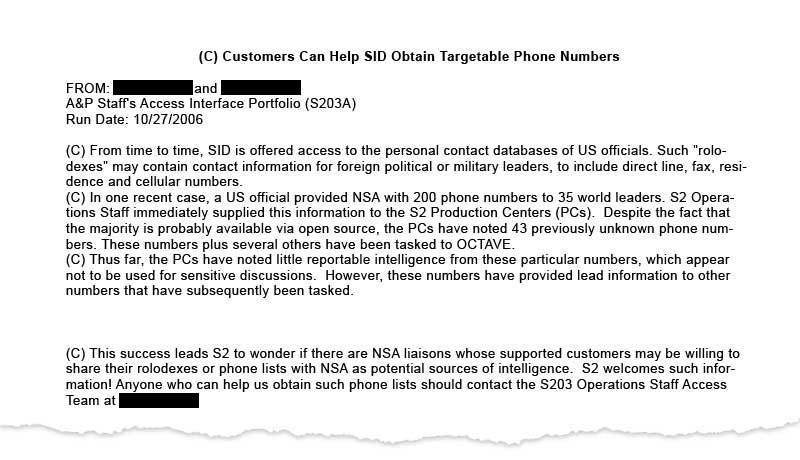
The Whistleblower Edward Snowden came across a Bush era NSA memo to its staff in 2006 that encouraged them to have their "Customers" (White House, State Dept, etc,) pass along any phone numbers of important people so the NSA could tap their phones, as reported in The Guardian.
In addition to snooping on world leaders, the NSA has intercepted phone calls around the world seemingly at random, collecting lots of juicy personal details, but doing nothing to stop terrorism.
But the memo acknowledges that eavesdropping on the numbers had produced "little reportable intelligence". In the wake of the Merkel row, the US is facing growing international criticism that any intelligence benefit from spying on friendly governments is far outweighed by the potential diplomatic damage.
The memo then asks analysts to think about any customers they currently serve who might similarly be happy to turn over details of their contacts.
"This success leads S2 [signals intelligence] to wonder if there are NSA liaisons whose supported customers may be willing to share their 'Rolodexes' or phone lists with NSA as potential sources of intelligence," it states. "S2 welcomes such information!"
They've managed to piss off everybody in Brazil, France and Germany, among others.  Putin isn't too thrilled either, but hey, he's Russian so I guess he doesn't count.

Saturday, September 14, 2013

Snowden Gets Some Respect

In a rare moment of candor, the director of the NSA James Clapper acknowledges Snowden as having a little positive impact and the judges of the FISA court overseeing the NSA have ordered the declassification of more of their rulings to advance the public debate.
The Fisa court ordered the Justice Department to identify the court's own rulings after May 2011 that concern a section of the Patriot Act used by the NSA to justify its mass database of American phone data. The ruling was a significant step towards their publication.
It is the second time in a week that a US court has ordered the disclosure of secret intelligence rulings. On Tuesday, a federal court in New York compelled the government to declassify numerous documents that revealed substantial tension between federal authorities and the surveillance court over the years.
On Thursday, James Clapper, the director of national intelligence, conceded that the NSA is likely to lose at least some of its broad powers to collect data on Americans.
He acknowledged that Snowden's disclosures had prompted a necessary debate: "As loath as I am to give any credit to what's happened here, I think it's clear that some of the conversations this has generated, some of the debate, actually needed to happen.
"If there's a good side to this, maybe that's it."
What Clapper didn't acknowledge is the fact that he and his agency have done everything they could to prevent that debate from ever happening, and still would love to bury Snowden in a small cell.

Thanks to the diligent efforts of the ACLU there will probably be more information revealed as a result of their FOIA requests filed in 2011.  The DOJ has tried to stonewall and obstruct the process every way they could, but cracks in the wall are finally appearing.
"We are pleased that the surveillance court has recognized the importance of transparency to the ongoing public debate about the NSA's spying," said Alex Abdo, staff attorney with the ACLU National Security Project. "For too long, the NSA's sweeping surveillance of Americans has been shrouded in unjustified secrecy. Today's ruling is an overdue rebuke of that practice. Secret law has no place in our democracy."

Wednesday, September 11, 2013

NSA Credibility Problem

On Tuesday 9/10/2013 the government finally declassified FISA and NSA court documents that reveal the agency lied to the court and Congress about their activities for years, and perpetuated those lies until Edward Snowden blew the whistle on them.

After years of government stalling and stonewalling, they finally released data to both the ACLU and Electronic Frontier Foundation who had filed FOIA requests on the court rulings.  Both the EFF and ACLU have had only a few hours to examine the documents, but here are their initial comments.

ACLU
“These documents show that the NSA repeatedly violated court-imposed limits on its surveillance powers, and they confirm that the agency simply cannot be trusted with such sweeping authority,” said Alex Abdo, staff attorney with the ACLU National Security Project. “The abuses revealed in these documents are alarming but also predictable. These violations are the inevitable result of allowing the NSA to assemble a vast database of sensitive information about every American. The documents provide further evidence that secret and one-sided judicial review is not an adequate check on the NSA’s surveillance practices.
EFF
Clapper's Continued Trouble with the Truth
On June 6, just days after the Guardian newspaper published the first of many articles on NSA spying, Director of National Intelligence Clapper attempted to reassure the public that the NSA telephone record program was limited and restrained. "The information acquired does not include ... the identity of any subscriber."
Documents released today show this to be false.  In an August 3, 2009 declaration to the FISA court, NSA Director Keith Alexander wrote that "the collected metadata thus holds contact information that can be immediately access as a new terrorist-associated telephone identified are identified."  While it is not surprising that the NSA can correlate a phone number to a person (phone book technology has been available for some time), here we have it in black and white that Dir. Clapper attempted to mislead the public.
The NSA's Word Games Confuse Even the NSA
As we've noted time and time again, the NSA plays with language, using words in non-standard ways.  After not reporting violations to the FISC for years, the NSA had this explanation: "there was never a complete understanding among the key personnel who reviewed the report ... regarding what each individual meant by the terminology used in the report."  The NSA presents this as an excuse why it misled the court.
Want to Know Why the NSA gave Raw Access to the CIA, FBI and NCTC in violation of a Court Order?
So did the Court, who ordered the NSA to explain the violation of its prior order. So did we. However, you're not going to find out today. Four pages of NSA Director Alexander's response to this question are redacted.
The Guardian published some analysis of the documents.
A judge on the secret surveillance court was so disturbed by the National Security Agency's repeated violations of privacy restrictions that he questioned the viability of its bulk collection of Americans' phone records, according to newly declassified surveillance documents.
Darrell Issa, the California Republican who chairs the powerful House committee on oversight and government reform, said that he backed legislation to "permanently cease" the bulk phone records collection.
"Government actions that violate the constitution cannot be tolerated and Congress must act to ensure the NSA and the intelligence community permanently cease such acts and hold the appropriate individuals accountable," Issa wrote to House majority leader Eric Cantor on Tuesday.

Saturday, August 17, 2013

Wyden "Just the Tip of a Larger Iceburg"

The latest NSA documents revealed by Edward Snowden show the NSA violated it's own rules thousands of times, with reactions from the NSA and Dianne Feinstein (no big deal) to Ron Wyden and Mark Udall "Just the Tip of a Larger Iceburg".  I think I'll go with Wyden on that conflict of opinion.

"While Senate rules prohibit us from confirming or denying some of the details in today's press reports, the American people have a right to know more details about the scope and severity of these violations, and we hope that the executive branch will take steps to publicly provide more information as part of the honest, public debate of surveillance authorities that the Administration has said it is interested in having.
"In particular, we believe the public deserves to know more about the violations of the secret court orders that have authorized the bulk collection of Americans' phone and email records under the USA PATRIOT Act. The public should also be told more about why the Foreign Intelligence Surveillance Court has said that the executive branch's implementation of Section 702 of the Foreign Intelligence Surveillance Act has circumvented the spirit of the law, particularly since the executive branch has declined to address this concern.
"We appreciate the candor of the chief judge of the Foreign Intelligence Surveillance Court regarding the court's inability to independently verify statements made by the executive branch. We believe that the court is not currently structured in a way that makes it an effective check on the power of the executive branch. This highlights the need for a robust and well-staffed public advocate who could participate in significant cases before the court and evaluate and counter government assertions. Without such an advocate on the court, and without greater transparency regarding the court's rulings, the checks and balances on executive branch authority enshrined in the Constitution cannot be adequately upheld."

Thursday, August 1, 2013

Wyden speaks to the Senate on NSA

Ron Wyden summarized this issue in a speech on the Senate floor yesterday, read it here.

He made several damning points.
1. The NSA has actively misled (i.e. lied to) the American people and Congress at every opportunity.
2. They are still doing it.
3. The phone metadata collection has produced no value in fighting terrorism. The "liberty or security" argument is a false choice, both are possible.
4. The programs NSA have in place have been abused repeatedly, producing numerous violations of even the miniscule rules the NSA has for themselves. The details of the violations are classified, but Wyden urged every legislator to go to the NSA and see the classified documents themselves. Wyden says the offenses are very serious and troubling, and, of course, much more serious than the NSA has admitted. to.

Wyden has been at this issue for years, he has always known the real truth, but could not reveal it in a lawful way until Snowden broke it open. He is a patriot and I'm proud to live in Oregon and have him as our Senator, and the same goes for Senator Jeff Merkley who has supported Wyden every step along the way.

Wednesday, July 24, 2013

House votes to not limit NSA spying

A bipartisan amendment to a Defense Appropriations bill in the house will be voted on this week.  It would revoke the flimsy legal justification the NSA uses to spy on everyone in the US.
Republican congressman Justin Amash prevailed in securing a vote for his amendment to a crucial funding bill for the Department of Defense that "ends authority for the blanket collection of records under the Patriot Act." The vote could take place as early as Wednesday evening.
"The people have spoken through their representatives," Amash told the Guardian on Tuesday. "This is an opportunity to vote on something that will substantially limit the ability of the NSA to collect their phone records without suspicion."
It will be the first such vote held by Congress on restricting NSA surveillance after the revelations from ex-contractor Edward Snowden, published in the Guardian and the Washington Post, that detailed a fuller picture of the surveillance authorities than officials had publicly disclosed – something blasted in a fiery Tuesday speech by Senator Ron Wyden, a prominent Democratic critic of the surveillance programs.
 I hope they pass it, and that the Senate does too.

UPDATE:   The House defeated the amendment 205 - 217, with most Democrats voting for the amendment (111 - 83) and most Republicans opposed (94 - 134).  I'd be inclined to support any Republican voting for it and inclined to oppose any Democrat who voted against it.

Saturday, June 29, 2013

NSA spies on entire EU

Another revelation from Edward Snowden, the NSA has an active to spy n EU diplomats in NYC, Brussels and Washington DC.  Well if you're going to spy on everybody everywhere, might as well include our friends and enemies alike.  Next I suppose they'll have tapes of JFK and Marilyn Monroe cavorting.

Sunday, June 23, 2013

Top Ten Absurd Statements about Spying

The national dialog being conducted by the defenders of NSA spying seems to rely on the assumption we don't have any intelligence, it is so littered with absurdly illogical false statements.  Since everyone seems to enjoy Top Ten lists, here's mine.

10. What the NSA is doing is legal.  You have to follow a trail of nitpicking twists of logic to give this statement any credence.  In short, acquiring information by spying isn't really spying if nobody knows about it or bothers to look at the data.  The NSA record of every phone call made in the US is deemed to not legally exist if nobody uses it.

9.  9/11 Could have been prevented if this had been in place.  Those making the argument have ignored a key aspect of historical record.  U.S. intelligence agencies knew the identity of the hijacker in question, Saudi national Khalid al Mihdhar, long before 9/11 and had the ability find him, but they failed to do so.
"There were plenty of opportunities without having to rely on this metadata system for the FBI and intelligence agencies to have located Mihdhar," says former Senator Bob Graham, the Florida Democrat who extensively investigated 9/11 as chairman of the Senate's intelligence committee.

8.  NSA surveillance disrupted "over 50" Terrorist plots.  There have been all sorts of numbers claimed, ranging from dozens (refuted by Mark Udall and Ron Wyden here) to maybe 10 in the US.  They cite David Coleman Headley, a key plotter in the deadly 2008 Mumbai attacks, but ProPublica did extensive research that shows NSA missed him entirely for 7 years until British Intelligence told them he was up to no good.

7.  We need to trade some Civil Liberties to fight Terrorism.  This ignores the fact that we are governed entirely by the Constitution, no law or policy can legally violate any of its provisions.  Period.  As argued in this article, we can not "trade" any violation of the Constitution without amending it, but that is precisely what the government is arbitrarily and secretly doing.

6.  All 465 Members of Congress were fully briefed on NSA spying.  Funny, other members of Congress, including one of the authors of the Patriot Act, Rep. Jim Sensenbrenner, R-Wis expressed outrage and concern about the data collection.

5.  President Obama says the NSA and FISA policies are "Transparent".  Well, maybe it is transparent to him, but not much of anyone else.  It operates in total secrecy, in fact anyone who is included in that "transparency" is prohibited from revealing anything about it, like Ron Wyden and Mark Udall.

4.  Edward Snowden does not classify as a Whistleblower.  Apparently whistleblowers can only blow the whistle on someone the current administration doesn't like.  Daniel Ellsberg thinks he's a hero, and we need more patriots like him. Ellsberg did a similar act in revealing the Pentagon Papers in 1971.

3.  Eric Holder defends the First Amendment right of Freedom of the Press.  Holder said he would never contemplate prosecuting reporters for publishing classified material, but his DOJ named Fox News reporter as a possible co-conspirator for publishing a news story, and they also bugged the Associated Press offices for 2 months.

2.  NSA spying has been effective in protecting US against Terrorism.  Boston Marathon bombers didn't seem to have any problems.

1.  The Government is concerned with preserving our Civil Rights.  The ACLU doesn't think so, and neither do I.  President Obama said he welcomed the dialog on the subject, while keeping it a close secret to prevent the possibility of any dialog.  Absurd.

Tuesday, June 18, 2013

What we learned about spies

The Edward Snowden saga playing on the front pages are giving us a lot of insights into the business of spying.
  1. Spies look like ordinary people living upper middle class lives.
  2. Even a high school dropouts can pull in six figure salaries if they're good with computers and can keep their mouth shut.
  3. It's pretty tough to keep anything secret with 1.5 million people having top secret clearance.  About one-third of those people work for private contractors.  The US has outsourced a lot of their spying business to industry.
  4. They can get any information they want, phone calls, emails, the works.  They can record your phone conversations and store them digitally and keep them as long as they want.